
Cisco CCNA v2.0 vs v1.1: What Has Changed?
By SkillsNest · 21 September 2026
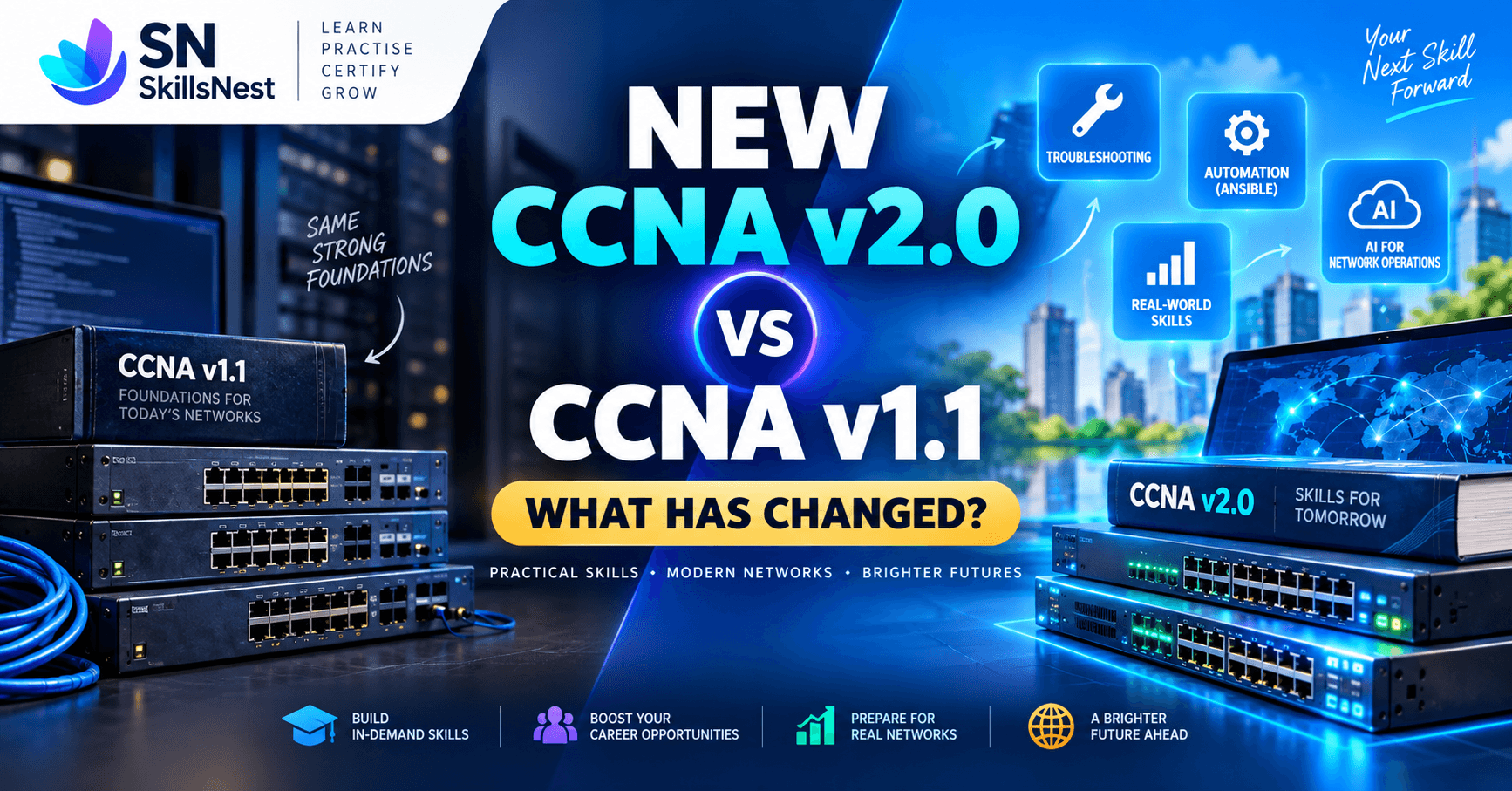
Cisco CCNA v2.0 launches in February 2027. Discover what changes from CCNA v1.1, including troubleshooting, AI, automation, DNS, DHCP and practical networking skills.
Cisco has announced a major update to its highly respected Cisco Certified Network Associate qualification. The new CCNA 200-301 v2.0 exam is scheduled to launch on 3 February 2027, replacing the current CCNA 200-301 v1.1 exam.
This is more than a minor syllabus refresh. CCNA v2.0 places greater emphasis on practical troubleshooting, automation, artificial intelligence and the skills needed to manage modern networks.
For learners considering a career in networking, cloud infrastructure or cybersecurity, the updated CCNA introduces a stronger practical focus alongside the networking fundamentals that have long formed the foundation of the certification.
When does the new CCNA v2.0 exam begin?
The key transition dates are:
- CCNA 200-301 v1.1: available until 2 February 2027
- CCNA 200-301 v2.0: launches on 3 February 2027
- Exam code: remains 200-301
- Exam blueprint: changes from v1.1 to v2.0
If you are already close to completing your current CCNA studies, you may still have time to take the v1.1 exam.
However, learners starting later in 2026 should understand the new topics and begin preparing for the updated objectives if they expect to sit the exam after the transition.
You can also explore the Cisco CCNA v2.0 (200-301) certification on SkillsNest.
CCNA v2.0 vs CCNA v1.1: what's different?
| Area | Current CCNA v1.1 | New CCNA v2.0 |
|---|---|---|
| Networking fundamentals | Strong focus on networking knowledge | Core networking knowledge remains |
| Troubleshooting | More limited troubleshooting requirements | Greater focus on diagnosing and resolving problems |
| Practical configuration | Configure and verify selected technologies | More configuration, verification and troubleshooting |
| DNS | Mainly understanding the purpose of DNS | Diagnose problems involving important DNS records |
| DHCP | Configure and verify DHCP clients and relays | Troubleshoot DHCP clients, relays and Cisco IOS DHCP servers |
| Switching | VLANs, trunks and EtherChannel | More realistic access-port scenarios, including PoE and different endpoints |
| Automation | General automation and programmability concepts | More practical use of Ansible and modern network-management methods |
| Artificial intelligence | Basic awareness of AI and machine learning | AI prompting, data security and agentic AI in network operations |
| Job-focused skills | Strong technical foundation | Greater emphasis on practical networking and troubleshooting skills |
Troubleshooting has a bigger role in CCNA v2.0
One of the most significant changes is the increased emphasis on troubleshooting.
The current CCNA syllabus asks learners to explain, describe, configure and verify different technologies. The updated syllabus goes further by requiring candidates to diagnose and troubleshoot problems.
This means learners may need to examine network diagrams, configurations, command output and symptoms before identifying what has gone wrong and how the issue could be corrected.
Areas receiving a stronger troubleshooting focus include:
- IP addressing
- VLANs and switching
- Routing
- DHCP
- DNS
- Wireless connectivity
- Access control
- Network security
- Device connectivity
This reflects an important part of real-world networking. Network professionals do not only need to understand terminology. They also need to investigate why a user cannot connect, why a device has received incorrect addressing information or why traffic is not reaching its intended destination.
More practical DNS and DHCP skills
DNS and DHCP are essential services in almost every business network.
In the previous syllabus, learners mainly needed to understand the role of DNS. Under CCNA v2.0, candidates will need a deeper understanding of diagnosing DNS-related issues involving common record types.
The updated exam also increases the level of DHCP knowledge required.
Learners will need to understand and troubleshoot areas including:
- DHCP clients
- DHCP relays
- DHCP servers running on Cisco IOS devices
- Incorrect addressing information
- Devices failing to obtain an IP address
These are common networking problems, making these skills particularly relevant to network support and engineering roles.
More practical switching knowledge
CCNA v2.0 introduces more realistic switch access-port scenarios.
Learners will need to understand how switch ports should be configured for different types of endpoints, including:
- Desktop computers
- Wireless access points
- IP phones
- Cameras
- Internet of Things (IoT) devices
- Other network-connected equipment
The updated syllabus also introduces Power over Ethernet (PoE) configuration.
PoE is widely used to provide power and network connectivity to devices such as IP phones, wireless access points and security cameras through a single Ethernet cable.
Instead of studying every technology entirely in isolation, candidates increasingly need to understand how multiple networking features work together.
Ansible and network automation
Modern networks can contain hundreds or thousands of devices. Configuring every router and switch manually can be slow and increases the possibility of human error.
CCNA v2.0 therefore gives network automation a more practical role.
Learners will be expected to understand how tools such as Ansible can be used as part of modern network configuration and management.
The updated syllabus also introduces or expands comparisons between different approaches to network management, including:
- Traditional device-based management
- Automation-based management
- Infrastructure as Code
- Cloud-based management
- Controller-based management
Understanding these approaches helps learners see how modern organisations can manage networks more consistently and efficiently.
Artificial intelligence and agentic networking
Artificial intelligence is becoming increasingly relevant across networking, cloud computing and cybersecurity.
The previous CCNA included basic AI-related concepts. CCNA v2.0 expands this area with topics involving:
- Creating effective AI prompts
- Data classification and sensitive information
- AI output formats
- Instructions and personas
- Agentic AI
- Network telemetry
- AI-assisted monitoring
- AI-assisted troubleshooting
Agentic AI systems can potentially use network information, APIs and automated tools to assist with investigating network problems or performing controlled tasks.
The new CCNA is not becoming an AI engineering certification.
Instead, the updated objectives introduce networking professionals to ways AI is beginning to influence how networks are monitored, operated, secured and troubleshot.
Does CCNA v2.0 require more practical skills than v1.1?
CCNA v2.0 places greater emphasis on practical understanding and troubleshooting.
Candidates will need to do more than recall networking concepts. The updated objectives place greater emphasis on diagnosing faults, interpreting network information and understanding how technologies should be applied in realistic situations.
That means effective preparation should include practical work such as:
- Configuring networks
- Reading command output
- Diagnosing faults
- Understanding network diagrams
- Comparing possible solutions
- Applying networking concepts to scenarios
- Practising troubleshooting rather than relying only on memorisation
This makes hands-on practice increasingly important when preparing for the updated exam.
What does CCNA v2.0 mean for SkillsNest learners?
The updated CCNA fits well with SkillsNest's focus on structured learning and exam preparation.
Learners preparing for CCNA v2.0 may benefit from combining learning material with regular opportunities to test their understanding, identify weaker subjects and revisit areas that require more practice.
As CCNA v2.0 resources become available, SkillsNest is designed to support preparation through:
- Structured learning that breaks difficult topics into manageable sections
- Practice questions covering relevant subject areas
- Mock exams to help measure exam readiness
- Scenario-based questions based on realistic networking problems
- Opportunities to practise troubleshooting rather than simply memorising answers
- Affordable access without repeatedly purchasing separate study resources
You can create a free SkillsNest account with no card required and explore the resources currently available on the platform.
Should you wait for CCNA v2.0?
You do not necessarily need to delay your CCNA studies.
The networking fundamentals covered by the current CCNA remain extremely important. Topics such as:
- IP addressing
- Subnetting
- Routing
- Switching
- VLANs
- Wireless networking
- Network security
will continue to provide an important foundation for the qualification.
If you are ready to take the CCNA v1.1 exam before 3 February 2027, you can continue with your existing study plan.
If you are beginning your studies now and expect to take the exam after the transition, make sure your training and practice materials cover the CCNA v2.0 objectives.
The most important thing is to prepare against the correct exam version and use up-to-date learning and practice material.
Start preparing for Cisco CCNA v2.0
CCNA v2.0 reflects the changing requirements of modern networking. It retains essential networking foundations while increasing the emphasis on troubleshooting, automation, AI and practical network-management skills.
These skills are relevant to people interested in roles such as:
- Network Support Technician
- IT Support Engineer
- Network Administrator
- Junior Network Engineer
- Infrastructure Engineer
- Network Operations Centre (NOC) Analyst
- Cybersecurity Analyst
Explore the Cisco CCNA v2.0 (200-301) certification on SkillsNest to learn more about the updated certification and the preparation resources available.
Create your free SkillsNest account and start building the networking knowledge and practical skills required for modern IT environments.
No card. No contract. Start for free.